A Beginner's Guide to Filling a Fountain Pen: Converter, Cartridge and Piston
Filling a fountain pen for the first time can feel like a small act of courage. There is a bottle of ink, a nib you would rather not damage, and the unshakeable certainty that you will finish the job with blue fingers. In reality, refilling is one of the simplest pieces of pen maintenance there is. Once you know whether your pen takes a cartridge, a converter, or has a piston built into it, the whole process takes about a minute — and with a little practice, no mess at all.
How a fountain pen gets its ink
Every fountain pen works on the same principle. Ink sits in a reservoir, travels down the feed — the finned black component beneath the nib — and reaches the tip by capillary action. As ink leaves, air has to get back in. That is why the reservoir must breathe, and why drips, airlocks and stubbornly dry nibs usually come down to a poor seal or a half-empty converter.
What changes between pens is the reservoir itself. Three systems cover almost everything you will meet as a beginner, and a few older designs are worth recognising too.
Cartridges: the easiest place to start
A cartridge is a small sealed plastic tube of ink that pushes onto a spike at the back of the section — the part you grip. Push it on, it is pierced, ink flows. Nothing to clean, nothing to carry but the cartridge itself.
The catch is compatibility. Many European pens take "standard international" cartridges, but several makers, including Lamy, Pilot, Platinum and Sailor, use their own shape. Buy the cartridges made for your pen, or check before ordering a box of fifty.
- Unscrew the barrel and put it somewhere you will not knock it off the desk.
- Pull out the old cartridge. If it is empty, bin it; if not, tape over the opening and keep it as a spare.
- Press the new cartridge firmly onto the section until you feel it pierce. A faint click, or a small release of ink, is normal.
- Wait a minute or two for ink to soak through the feed, then screw the barrel back on.
A sealed cartridge keeps for years; a pierced one begins drying the moment it is opened. If your writing starts dark and then fades, the cartridge is nearly done — swap it before the nib runs dry and starts skipping.
Converters: bottled ink without the fuss
A converter is a refillable cartridge: a small piston or squeeze mechanism that plugs into the same place. It lets you use bottled ink, which costs less per millilitre, comes in far more colours, and is easier to flush out when you fancy a change.
Converters come in twist and slide versions and, as with cartridges, some are proprietary. A well-seated converter feels snug. If it wobbles, or ink gathers around its base, it is not fitted properly.
- Fit the converter, then twist or slide the plunger down to expel any air.
- Dip the nib into the ink so the breather hole — the small opening above the slit — is submerged, but avoid dunking the section itself.
- Draw ink slowly. Rushing creates bubbles and a half-filled converter.
- Lift the nib out and twist two or three drops back into the bottle. This primes the feed and clears the air gap at the top.
- Wipe the nib and section with a tissue, working from the base of the nib towards the tip, then write a few lines to settle the flow.
For the fullest possible fill, some people remove the converter and load it directly with a blunt syringe before refitting it. It is neat, but you will need to prime the feed afterwards by twisting a drop through. The nib-first method is quicker and leaves the pen ready to write.
Piston fillers and other built-in systems
On a piston filler, the reservoir is the barrel. A knob at the end of the pen drives a piston inside it, and there is no cartridge or converter to lose. The routine is much the same: knob down, nib in the ink, knob up slowly, then wipe. These pens hold more ink than a converter and are remarkably fuss-free once filled.
You will also come across vacuum fillers, which use a plunger and a seal, lever fillers on vintage pens, and eyedroppers, where ink goes straight into the barrel and the threads are sealed with silicone grease. Vintage lever fillers rely on a rubber sac that perishes with age. If the lever feels stiff or crunchy, stop and have the pen looked at rather than forcing it.
Keeping it tidy
- Work over a folded sheet of kitchen paper, not over the carpet.
- Wedging the ink bottle in a mug or a roll of tape stops it tipping mid-fill.
- Wipe the nib base-to-tip. Wiping the other way drags ink into the section, where it seeps out later.
- Cap the bottle before you do anything else.
- Store filled pens nib-up or flat; stored nib-down for long periods, many pens leak into the cap.
- Flush with lukewarm water when changing colour, and never use hot water, alcohol or solvents on a pen.
When the first fill misbehaves
Nothing happens when I write
Ink has not reached the nib yet. Wait a minute, then twist the converter gently to push a drop through, or tap the nib against scrap paper. Do not press hard to force it.
Ink blobs or drips
Usually a flooded feed. Wipe the nib, hold the pen nib-up for a moment, and write a few lines. If it continues, check that the cartridge or converter is firmly seated and that there is no ink sitting in the cap.
The converter draws almost nothing
Air is getting in somewhere. Reseat the converter, dip the nib deeper, and turn the plunger slowly. If it still will not fill, the converter may be worn; they are inexpensive to replace.
Start with one bottle
Choose a single everyday ink in blue or black from an established maker, keep a tissue and a steady surface to hand, and refill when the writing starts to fade rather than when the pen runs completely dry. If you would rather not christen a good pen with a spill, practise on a cheap one first. After two or three goes you will stop thinking about it, which is exactly the point: a fountain pen should be a pleasure to use, not a chore to maintain.
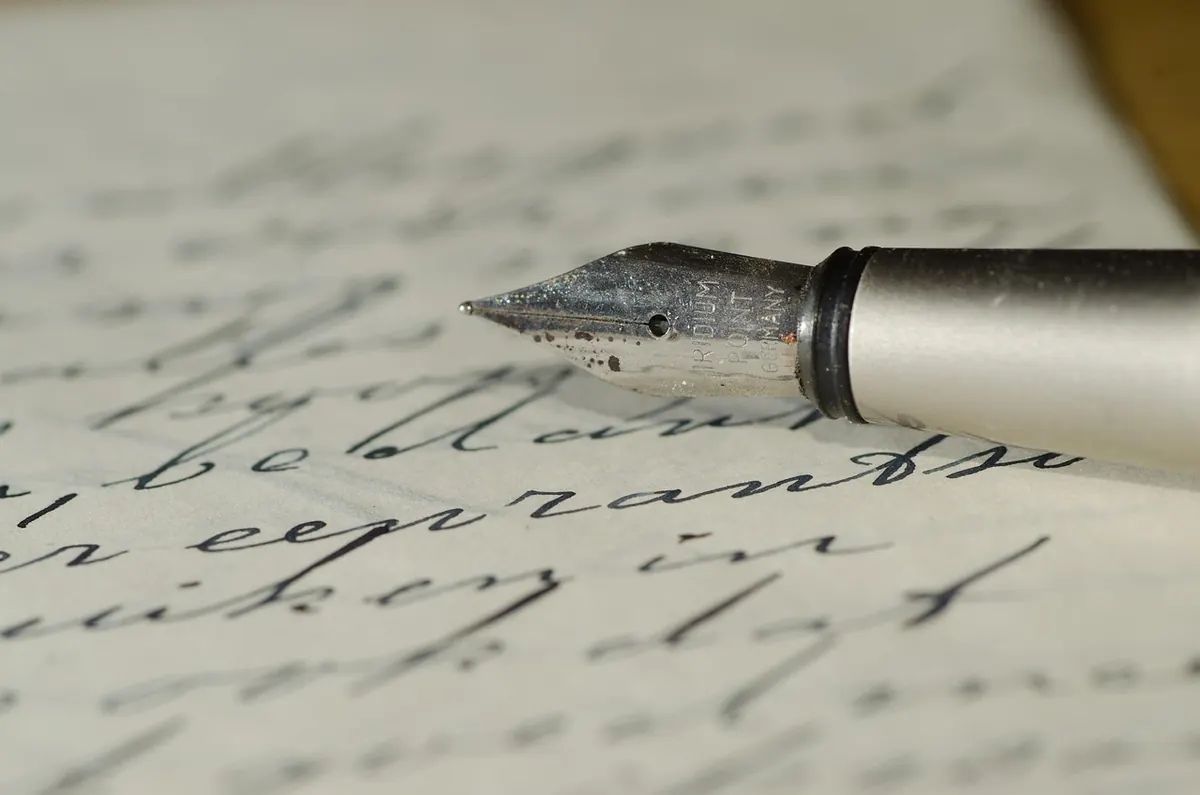
Photo: Andrys / Pixabay